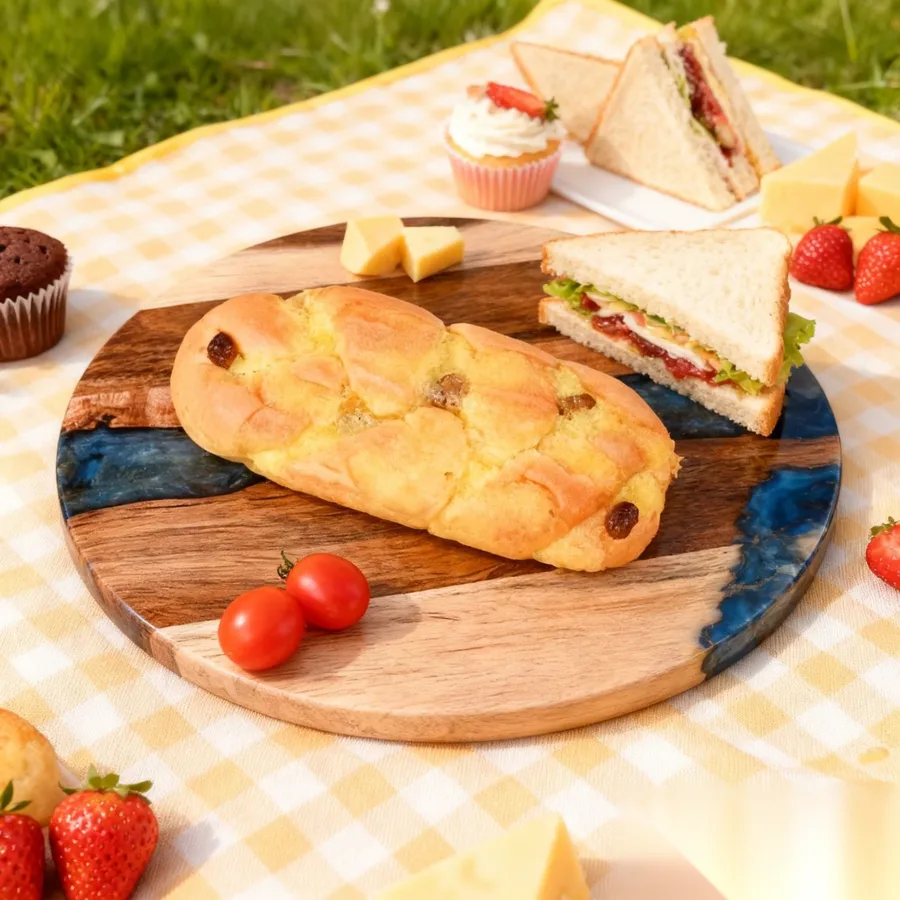
Every PEIMI resin and wood board begins as raw hardwood and ends as a one-of-a-kind object. This behind-the-scenes look explains how we select wood, pour resin, control bubbles, cure, finish, and inspect—so you understand exactly what goes into the piece on your counter.
Want to see it for yourself? Message PEIMI for production videos and factory information.
Request Factory Info →Wood Selection: Acacia & Walnut
We work primarily with acacia and black walnut. Acacia is dense, water-resistant, and warm-toned—ideal for everyday boards. Walnut is darker and denser, positioned as a premium line. Each plank is chosen for grain character that will complement the resin pour.
Kiln Drying & Stability
Wood is kiln-dried to a stable moisture content (around 6–10%) before any resin work. Stable wood means less movement after shipping, fewer cracks, and a tighter bond with the epoxy.
Resin Pouring by Hand
The signature "river" or geode effect is poured by hand. We dam the wood edges, mix food-safe epoxy, tint it, and pour in layers. Timing matters: temperature and humidity change how the resin flows and how colors blend. This is why no two PEIMI boards are exactly alike.
Bubble Control & Clarity
Trapped air creates cloudy voids. We use a pressure pot or vacuum step, plus a heat pass, to draw bubbles out before the resin sets. The result is a glass-clear pour that shows the wood beneath.
Curing Time
Epoxy needs days—not hours—to fully cure to a food-safe, hard finish. Rushing this step risks a soft or odorous surface. We cure in a controlled environment, then de-mold.
Sanding & Food-Safe Finish
After de-molding, boards are sanded through progressively finer grits to a smooth, touch-dry feel. Edges are rounded, and a food-safe oil or wax is applied. Non-slip feet or juice grooves are added where the design calls for them.
Quality Control
Every board is inspected for: even pours, no trapped dust, smooth edges, stable wood, and a fully cured, odor-free finish. Pieces that don't pass are reworked or recycled. Wholesale buyers can request pre-shipment inspection on first orders.
Like what you see?
Order a sample or start a custom wholesale run with your colors and branding.
Start a Sample →FAQ
What wood does PEIMI use?
Primarily acacia and black walnut, both kiln-dried for stability. Acacia is the everyday workhorse; walnut is the premium, darker line.
Is the resin food safe?
Yes. We use food-safe, fully cured epoxy and a food-safe finish. Each batch is cured in a controlled environment before finishing.
Why is every board different?
Resin is poured by hand and reacts to temperature, humidity, and timing. Wood grain is also unique, so each piece is effectively one-of-a-kind.
How do you prevent bubbles in the resin?
We use a pressure pot or vacuum step plus a heat pass to remove trapped air before the epoxy sets, giving a clear, glass-like finish.
How long does it take to make one board?
Including cure time, several days. The epoxy alone needs days to reach a fully cured, food-safe state.
Can I request custom colors or branding?
Yes. We offer custom resin colors, sizes, laser engraving, and private-label packaging for wholesale and events.
How are boards quality checked?
Each board is inspected for even pours, smooth edges, stable wood, and a cured, odor-free finish. Failing pieces are reworked or recycled.
Do you offer factory verification for buyers?
Yes. We can share production videos and resin safety documentation, and support pre-shipment inspection on first orders.