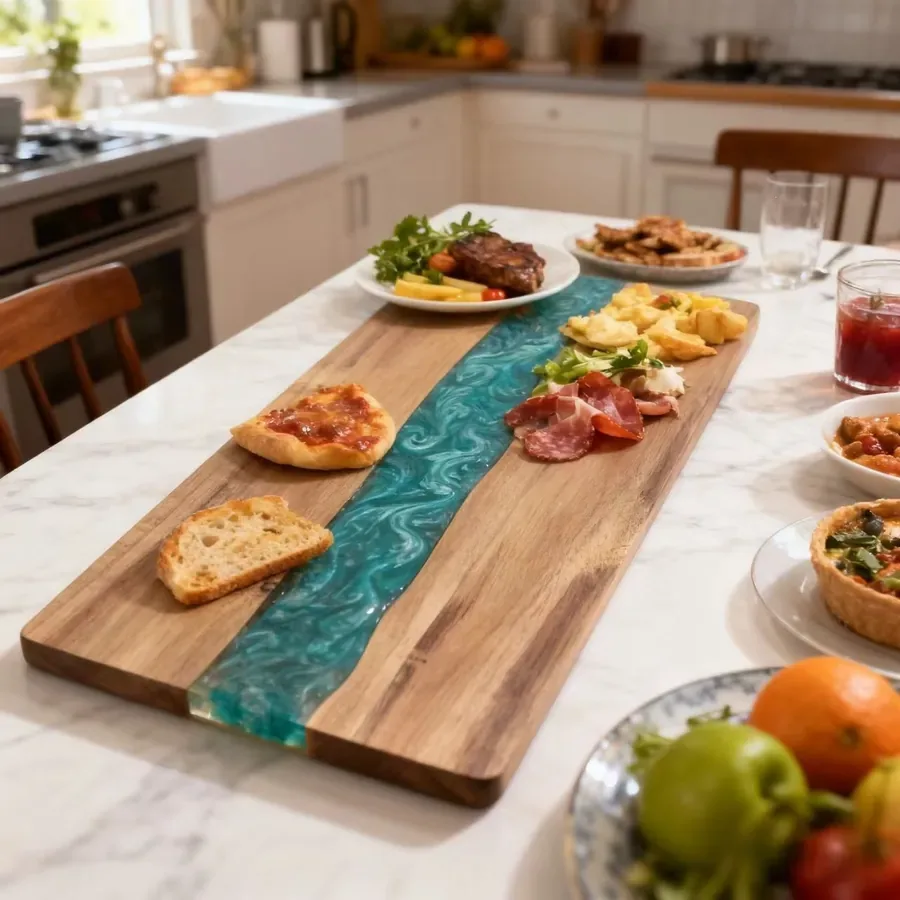
If you are a retailer, brand owner, or distributor looking to source epoxy resin cutting boards wholesale, the market is full of options—but not all suppliers deliver the same quality, consistency, or service. The right cutting board can become a bestseller in kitchen stores, gift shops, and online catalogs, while the wrong one leads to returns, complaints, and dead stock.
This guide walks you through what matters when buying resin and wood cutting boards in bulk: materials, craftsmanship, supplier screening, customization, pricing, packaging, and logistics. By the end, you will know how to choose a supplier that protects your margin and your reputation.
Need a quote or samples? Message PEIMI on WhatsApp with your target quantity and market.
Get a Wholesale Quote →Why Epoxy Resin Cutting Boards Are a Strong Wholesale Category
Epoxy resin cutting boards sit at the intersection of kitchen utility and home décor. Unlike plain plastic or bamboo boards, they carry a handcrafted story, unique patterns, and premium price points. Consumers buy them as functional kitchen tools, charcuterie serving boards, wedding gifts, and holiday presents.
From a retailer's perspective, the margins are attractive because the perceived value is high. A well-made epoxy wood board can retail for 3–5 times its landed cost, especially when paired with attractive packaging and a clear origin story.
Who buys these boards?
- Kitchenware and home-goods retailers looking for premium SKUs
- Charcuterie and cheese-board brands that want distinctive serving pieces
- Corporate gift buyers seeking personalized, high-perceived-value items
- E-commerce sellers in the handmade, artisan, and sustainable niches
Materials & Craftsmanship: What Separates Premium from Cheap
Not every "epoxy cutting board" is equal. The two main components—wood and resin—determine durability, food safety, and visual appeal.
Wood selection
Acacia is the most popular hardwood for resin boards because it is dense, water-resistant, and has a warm, varied grain. Black walnut offers a darker, more luxurious look and is often used for higher-end lines. Both woods should be kiln-dried to a stable moisture content (6–10%) to prevent warping or cracking after shipping.
Resin quality
The resin must be food-safe, FDA/EU compliant, and fully cured. Low-grade resin can yellow within months, develop micro-cracks, or emit odors. Ask your supplier for a resin safety certificate and whether they use a pressure pot or vacuum chamber to remove bubbles.
Finish and edges
Look for:
- Smooth, sanded edges with no rough splinters
- Even resin pours without visible voids or trapped dust
- Food-safe mineral oil or wax finish that is dry to the touch
- Non-slip feet or juice grooves on boards designed for heavy cutting
Design Trends That Sell in 2026
Wholesale buyers who understand current design trends can place smarter orders. Here are the styles that move consistently:
- Ocean / river boards: Deep blue or turquoise resin flowing through light wood. Perfect for coastal brands and gift markets.
- Minimalist clear resin: Nearly invisible resin that protects the natural edge while keeping focus on the wood grain.
- Geode and metallic accents: Boards with glitter, mica, or stone-like edges for the premium décor segment.
- Live-edge serving boards: Boards that retain the natural tree edge, popular for charcuterie and cheese presentation.
- Holiday and seasonal themes: Warm reds, greens, and gold resin tones for Q4 gifting.
PEIMI produces each of these styles in small batches. Browse the full product collection to see which designs align with your brand.
Supplier Checklist: 10 Questions Before You Order
Use this list to screen any epoxy cutting board supplier before committing to a bulk order:
- Can you share photos and videos of the actual production floor?
- What wood species and resin brand do you use?
- Do you provide food-safety certificates for the resin and finish?
- What is your typical MOQ per design and per order?
- Can you produce custom dimensions, shapes, colors, or branding?
- What is your standard production lead time?
- Do you offer pre-shipment inspection or third-party QC?
- What packaging options do you offer (retail box, mailer, bulk wrap)?
- Which countries have you shipped to, and can you share references?
- What payment terms do you accept?
Suppliers who hesitate on transparency—especially around resin safety or production photos—are a risk. Reliable factories answer these questions directly.
Want a factory tour or sample photos? PEIMI can share production videos and resin safety documentation on request.
Request Factory Info →How to Verify a Factory Before Your First Order
Factory verification is one of the highest-leverage steps in wholesale buying. A verified supplier reduces the risk of quality failures, delays, and miscommunication.
Step 1: Review their digital presence
Check the supplier's website, social media, and any third-party profiles. A professional site with consistent product photography, clear contact information, and detailed production content is a positive sign.
Step 2: Request real production media
Ask for a short video walkthrough of the cutting, resin pouring, curing, sanding, and finishing areas. Stock photos are easy to fake; real factory footage is harder.
Step 3: Order samples, not just catalogs
Always inspect physical samples before placing a bulk order. Check weight, finish smoothness, resin clarity, edge quality, and smell. A sample is a small cost compared to a bad container.
Step 4: Start with a small test batch
Even after samples, place a pilot order (often 50–100 pieces) to confirm consistency across multiple units before scaling to full container loads.
Customization & Branding Options
Branding turns a generic board into your product. Common customizations include:
- Laser engraving: Logo, monogram, or care instructions on the back or front
- Custom resin colors: Match Pantone or brand colors for seasonal lines
- Private-label packaging: Kraft box, sleeve, or hang tag with your branding
- Board dimensions: Adjust length, thickness, and handle style for your market
- Handle cutouts or juice grooves: Functional details that differentiate from competitors
Custom work usually requires a one-time design confirmation and a higher MOQ than stock designs. Lead times are also longer because molds, colors, and packaging must be prepared.
MOQ, Pricing & Lead Time
Pricing for wholesale epoxy cutting boards depends on size, complexity, wood species, finish, packaging, and order volume.
| Factor | How It Affects Price |
|---|---|
| Board size | Larger boards use more wood and resin |
| Wood species | Black walnut is generally premium over acacia |
| Resin design | Complex geode/metallic effects take more labor |
| Finish quality | Multiple sanding and oiling steps raise cost |
| Packaging | Retail boxes add material and assembly time |
| Order quantity | Higher volumes lower per-unit cost |
Lead times: Stock designs typically ship in 2–4 weeks after order confirmation. Custom designs add 2–4 weeks for sample approval and material preparation. Always confirm lead times in writing, especially before peak seasons like Q4.
Packaging & Shipping for Wholesale Orders
Resin boards are heavy and fragile. Poor packaging is a leading cause of damage and returns.
Packaging options
- Bulk wrap: Each board wrapped in PE foam and stacked in a master carton. Lowest cost, best for B2B resellers.
- Retail box: Individual kraft or white box with product info. Best for direct-to-consumer sellers.
- Mailer-ready: Box + inner foam for e-commerce parcel shipping. Higher cost but reduces damage rates.
Shipping modes
- Sea freight (FCL/LCL): Most economical for bulk orders. Plan 25–40 days transit.
- Air freight: Faster but expensive; useful for samples or urgent restocking.
- Express courier: Best for samples and very small test batches only.
Ready to source epoxy resin cutting boards wholesale?
Tell PEIMI your target market, quantity, and preferred designs. We will reply with options, lead times, and pricing.
Start a Wholesale Inquiry →Wholesale Epoxy Cutting Board FAQ
What is the typical MOQ for epoxy resin cutting boards wholesale?
MOQs vary by supplier and design. Stock designs often start at 50–100 pieces per style, while custom designs may require 200–500 pieces. Some factories offer mixed-container loads across multiple SKUs to reduce risk.
Are epoxy resin cutting boards food safe?
Yes, when made with food-safe epoxy resin and a fully cured finish. Ask your supplier for certificates confirming the resin meets FDA or EU food-contact standards. Avoid boards that smell strongly of chemicals or have sticky surfaces.
How long does production take for a wholesale order?
Stock designs usually take 2–4 weeks. Custom designs can take 4–8 weeks including sample approval. Sea freight adds 25–40 days depending on destination.
Can I add my own logo to wholesale cutting boards?
Yes. Laser engraving, printed hang tags, and custom retail boxes are common branding options. Most suppliers require a small setup fee for the first order and a higher MOQ for fully custom designs.
What wood works best with epoxy resin for cutting boards?
Acacia and black walnut are the most popular choices. Acacia offers hardness and warm grain at a mid-range price. Black walnut is denser, darker, and positioned as premium. Both bond well with epoxy when properly kiln-dried.
How do I avoid receiving low-quality boards from overseas?
Order samples first, request factory videos, confirm resin safety certificates, and place a small pilot batch before scaling. Pre-shipment inspection by a third-party QC service is also recommended for first-time orders.
What is the best packaging for shipping resin boards internationally?
Each board should be wrapped in protective foam and separated from neighboring boards to prevent rubbing. Retail boxes add cost but improve presentation. For e-commerce, mailer-ready boxes with inner foam reduce damage rates.
Can I mix designs and sizes in one wholesale order?
Many suppliers allow mixed SKUs within a single container or minimum order value. Confirm the mix rules upfront, as some designs may have different MOQs due to materials or labor.